
Drift Series Overview
Everything a new driver needs to know, from your first question to your first run.
Welcome to CKB
Clutch Kickback is alternative motorsports: competitions with culture built into the championships.
CKB sits between the energy of the underground and the legitimacy and polish of corporate motorsports. It is legal and professionally produced, with the culture still in the room, and open to everyone at every skill level.
CKB runs two championships, the Drift Series and the Sprint Series. This overview is about the Drift Series.
How we are different
- Race for your prefecture, not for a corporationIn most racing leagues, a team is built around an owner, a sponsor or a brand. A CKB Team is a prefecture, so you drive for where you are from.
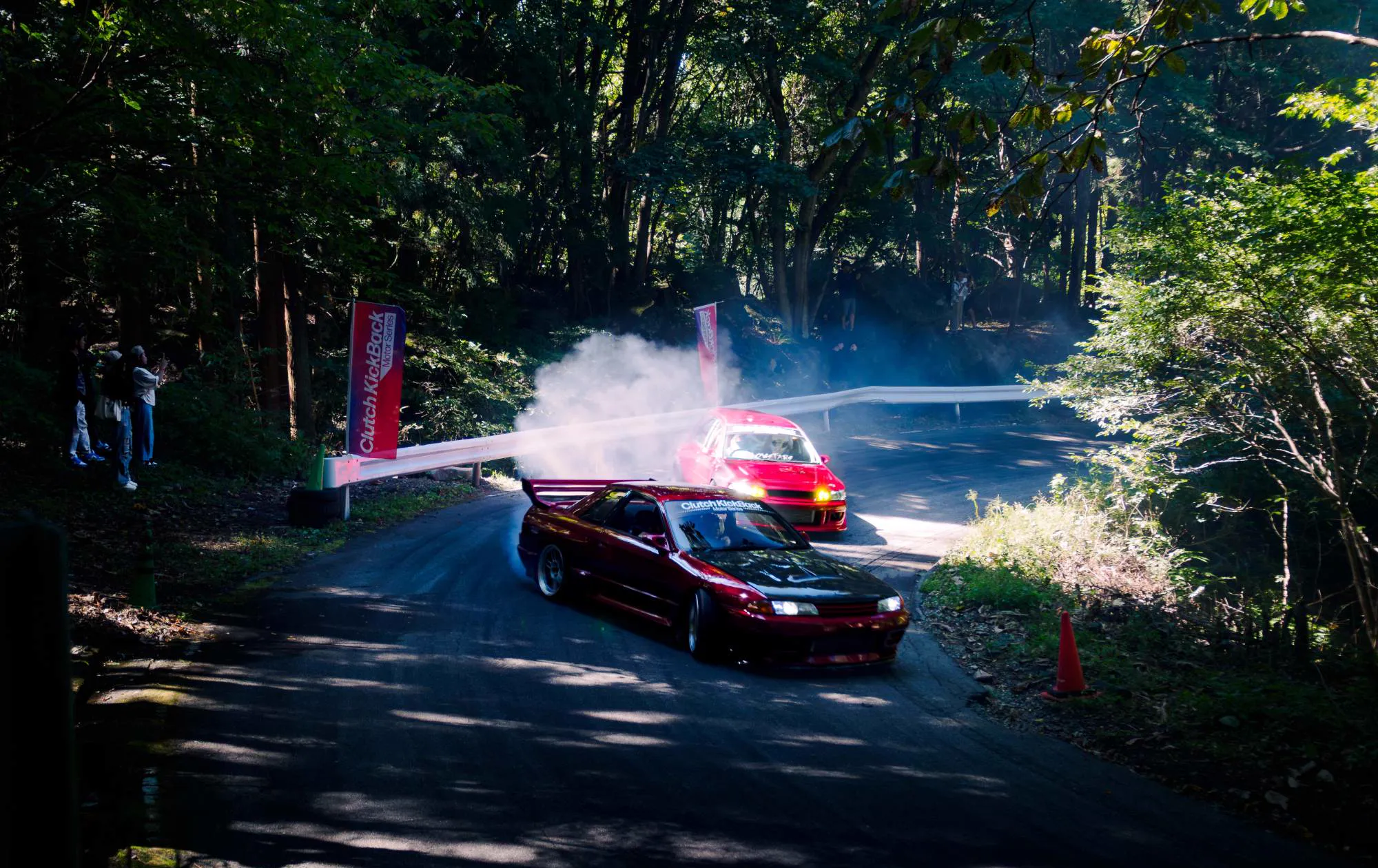
- A different competition formatOur format is called Gap Attack. In every run, two cars drive the course together over a fixed distance, one leading and one chasing. The gap between them is measured, not subjectively judged.
- Anyone can enter. Only the best can win. Sign up online in minutes.If you are 18 or over and own your car, you can sign up for an Event online. Winning is another matter. Prizes pay results, and every podium place is won on track, never arbitrarily given.
- Three main classes, set by your tiresThere are three main classes: Street Class, Modified Class and Full Spec Class. Your class depends only on your tire width and tire type. Otherwise, you can build your car however you like, as long as it meets the safety and bodywork rules.
How Drift is different
The format is called Gap Attack. The name is new, but the format itself is not. It comes from mountain-pass roads, where drivers competed uphill from point to point. CKB turned this into a formal competition. It combines drifting, measured scoring and precise road-course driving, and it is held on race circuits and closed roads.
The format is measured, not subjectively judged. In every run, one car leads and the other chases. The score is the gap between the two cars, measured over the whole run. The bigger the gap the Lead car makes, and the longer it keeps it, the higher the Lead’s score. The Chase car tries to stay as close as it can. If the Chase car passes the Lead car, the Lead’s score goes down.
Can I enter?
Most likely. If you meet these requirements, you can enter.
You
- At least 18 years of age
- Registered online and accepted before Event day
Your car
- Your own
- Four wheels, tow hooks front and rear, and a working muffler, in sound condition
- Rear-wheel drive
- No formula cars, vans, kei vans, SUVs or RVs
Your safety
- An FIA-approved helmet, suit, gloves and shoes
- A mounted seat and a secured, covered battery
- Recommended: a HANS device and a fire extinguisher
Your class
Your tires, front and rear, set your class. There are three classes, from street builds to top-level competition cars.
The widths are ceilings, so your car may fit more than one class. Build your car however you like, as long as it is within the class limits.
You choose your class when you register for an Event online. You enter one class at each Event.
| Class | Rear tire, at most | Tires | Built for |
|---|---|---|---|
| Street | 245 mm | Street tires only | Street builds |
| Modified | 265 mm | Street tires or semi-slicks, with tread | More developed competition cars |
| Full Spec | 285 mm | Any tire with tread (no slicks). All body panels fitted and painted or wrapped | High-power, top-level cars |
Event day
An Event may include Open Practice, held the day before or on the morning of the competition. You can enter Open Practice on its own, without competing. Every Driver must attend the Driver’s Meeting before going on track. Race Control runs the track, and you must obey its flags immediately.
The heat
A heat is a contest between two Drivers, made up of two runs.
In each session, pairs of Drivers start one pair at a time. At the start, the Lead car lines up on the start line and the Chase car lines up 30 m behind it. One signal starts both cars.
A run covers the whole course, from the start line to the finish line. After the first run, the two Drivers swap roles for the second run, so each Driver leads once and chases once.
Courses are usually one to two kilometers long, flat or uphill, and tight and technical. No pit stops, repairs or tire changes are allowed during a session.
Gap Attack
The format is called Gap Attack because the result is decided by the gap between the two cars.
During each run, the distance between the two cars is measured continuously along the course, from the start signal until both cars have crossed the finish line. These measurements are added together to make the score for that run.
The score belongs to the Lead Driver. The bigger the gap and the longer the Lead keeps it, the higher the score. If the Chase car passes the Lead car, the score goes down, and it can go below zero.
Each Driver leads one run in a heat. The Driver with the higher score from the run they led wins the heat. Crossing the finish line first does not win a heat.
Drift sections
You must drift through every drift section, from its entry marker to its exit marker. You must not drift in a no-drift section. Everywhere else on the course is a free section, where you can choose whether to drift.
The section plan is published before the first session, so you can plan your line through the whole course. You can also practice it during Open Practice.
A spin or a stop does not void your run, but it will hurt your score. You can still recover, because your opponent can make mistakes too. Your run is void if you straighten in a drift section, miss a drift section, leave the course, or cause avoidable contact. A void run loses the heat.
The Curator
“But what if a driver intentionally drifts too shallow to drive faster around the corners?”
The Curator is a drift aficionado appointed for every Event. The Curator protects the spirit of the discipline by making sure every run is properly drifted.
The Curator is not a judge.
The Curator only rules on drifting: whether a drift section was missed, whether a Driver straightened, and whether a drift lasted through the whole section. The Curator’s decision comes within two minutes of the run and is final.
Relative scoring only
Remember, you are not racing against the clock. You are competing only against the other Driver in your heat.
Your score is not absolute, and it cannot be compared with scores from other heats. It only reflects what happened in your heat.
Winning an Event
Up to sixteen Drivers start in a class, in the order entries were accepted, so enter early.
At every Qualifying Event, each class runs a knockout. If more than eight Drivers start, the knockout begins with an Opening Round. After that come the Quarter-Finals, the Semi-Finals and the Event Final. If you lose a heat, you are out, except in the Opening Round, where the closest losers can still go through. Pairings are drawn at random, and nobody is seeded.
The winner of the Event Final wins the class, and the top three in each class win prizes on the day.
Drive for your prefecture
Every CKB Team represents a region, not a sponsor. In Japan, each prefecture has one Team. Outside Japan, each approved region has one Team.
- You declare your Team when you register. It is where you are from or drive the most.
- New Teams are automatically added to the running when new Drivers register to compete.
- It is your Team for the Season, unless the League approves a transfer.
- A Team can enter any number of Drivers, so bring your friends.
- A Team may take a corporate sponsor, but its name always starts with its prefecture.
Scoring for your Team
At every Event, your Team’s two best-placed Drivers in each class earn Team Points. Your Team’s Event Score adds together its two best class results. A class result is your Team’s best Team Points score in that class.
A Team with more Drivers has no advantage. Only the two best-placed Drivers from each Team score in each class. Other Drivers from the same Team are removed from the order before Team Points are given out, so extra Drivers cannot push another Team’s Drivers down the points.
The CKB Championship
Drivers’ Championship
- A Season has anywhere from four to eight Qualifying Events, then the CKB Finals, the last Event, where the champions are decided.
- At each Qualifying Event, the top two Drivers of each class qualify for the CKB Finals.
- The CKB Finals runs the same knockout format, ending in a Championship Final, and its winner is the Drift Series winner for that class.
Team Championship
- Each Team’s Event Scores from every Event, including the CKB Finals, are added up into a Season Score.
- The Team with the highest Season Score wins the Team Championship.
- The prize pool pays the top eight Teams, split equally among the Drivers who scored for each.
A fresh chance at every Event
A Driver’s results are not cumulative across the Season. A bad day or a missed Event costs you nothing at the next one. At every Qualifying Event, your goal is to finish in the top two of your class and earn an invitation to the CKB Finals.
Conduct
Drive clean, and never drive impaired. Reckless or unsporting driving can cost you the Event, or your place in the Season. Treat all participating Drivers, staff, officials and spectators with respect, and follow all venue rules on Event day.
You can protest a result for free, in writing, within 30 minutes unless the Event specifically sets another time. The one call you cannot protest is the Curator’s ruling on your drifting.
Thank you
Thank you for your attention, and we look forward to seeing you out on the track.